Air quality
Wildfire Smoke and Air Quality: How to Read the AQI and Protect Your Health
What wildfire smoke does to air quality, how to read AQI levels for PM2.5, and practical steps to protect yourself indoors and outdoors.

Wildfire smoke can travel hundreds of kilometres from the fire itself, which means the air outside your window can turn unhealthy even when the nearest flames are a region away. The single most useful number for deciding what to do is the Air Quality Index (AQI) for fine particulate matter.
Why wildfire smoke is harmful
Smoke is a mix of gases and tiny particles. The particles that matter most are PM2.5 — particles 2.5 micrometres across or smaller — because they reach deep into the lungs and can enter the bloodstream.
- Short-term effects include coughing, stinging eyes, headaches and shortness of breath.
- People with asthma, COPD or heart disease, older adults, children and pregnant people are at higher risk.
- Smoke levels can change hour to hour as wind shifts, so check conditions more than once a day.
How to read the AQI
The US EPA scale runs from 0 to 500 and is split into six colour-coded categories. Higher numbers mean more pollution and greater health concern.
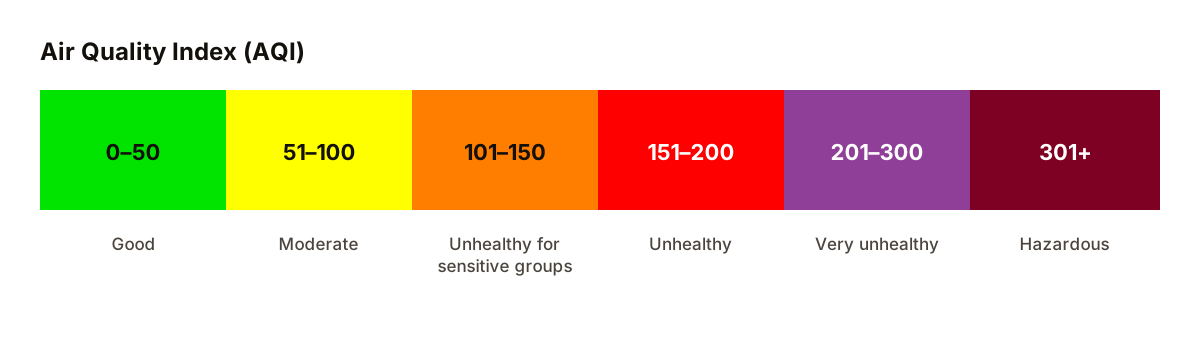
0–100: Good to Moderate
Air quality is acceptable for most people. Unusually sensitive people may want to limit prolonged outdoor exertion at the upper end of Moderate.
101–200: Unhealthy for sensitive groups to Unhealthy
Sensitive groups should reduce time outdoors. Above 150, everyone should cut back on strenuous outdoor activity.
201 and above: Very Unhealthy to Hazardous
Stay indoors with windows closed and follow guidance from local health authorities.
Protecting yourself indoors
- Close windows and doors, and set your HVAC to recirculate.
- Run a portable HEPA air purifier in the room where you spend the most time.
- If you have central air, use a MERV 13 or higher filter.
- Avoid adding indoor pollution: skip candles, frying and vacuuming without a HEPA filter.
Protecting yourself outdoors
A well-fitted N95 or FFP2 respirator filters smoke particles; cloth and surgical masks do not. Plan errands for times when smoke is lighter, and keep car windows closed with air on recirculate.