Fire data
Lightning or People? What Started 2026's Wildfires, State by State
People started about 7 in 10 US wildfires with a known cause in 2026. But in Colorado, Utah and Nevada, lightning started most of them. The state-by-state data.
Every incident FireRadar tracks in the United States comes with a cause field filled in by the reporting agency. We pulled every US record with a discovery date between January 1 and October 31, 2026 — 34,894 in all — and sorted them by what started them. The national answer won't surprise fire managers. The state-by-state answer is more interesting.
The national picture: mostly people
Among the fires whose cause had been determined, 9,544 were human-caused and 3,829 were natural — almost all of those lightning. That's about 71% human-caused, or roughly five fires started by people for every two started by lightning.
The bigger number is the one most fire maps don't show: 62% of the records still listed the cause as undetermined. That's normal. Investigations take weeks or months, small fires often never get a formal finding, and a cause field is usually the last thing updated in an agency's system. So read every percentage below as a share of fires with a known cause, not of all fires.
State by state, the split changes completely
Where lightning dominates
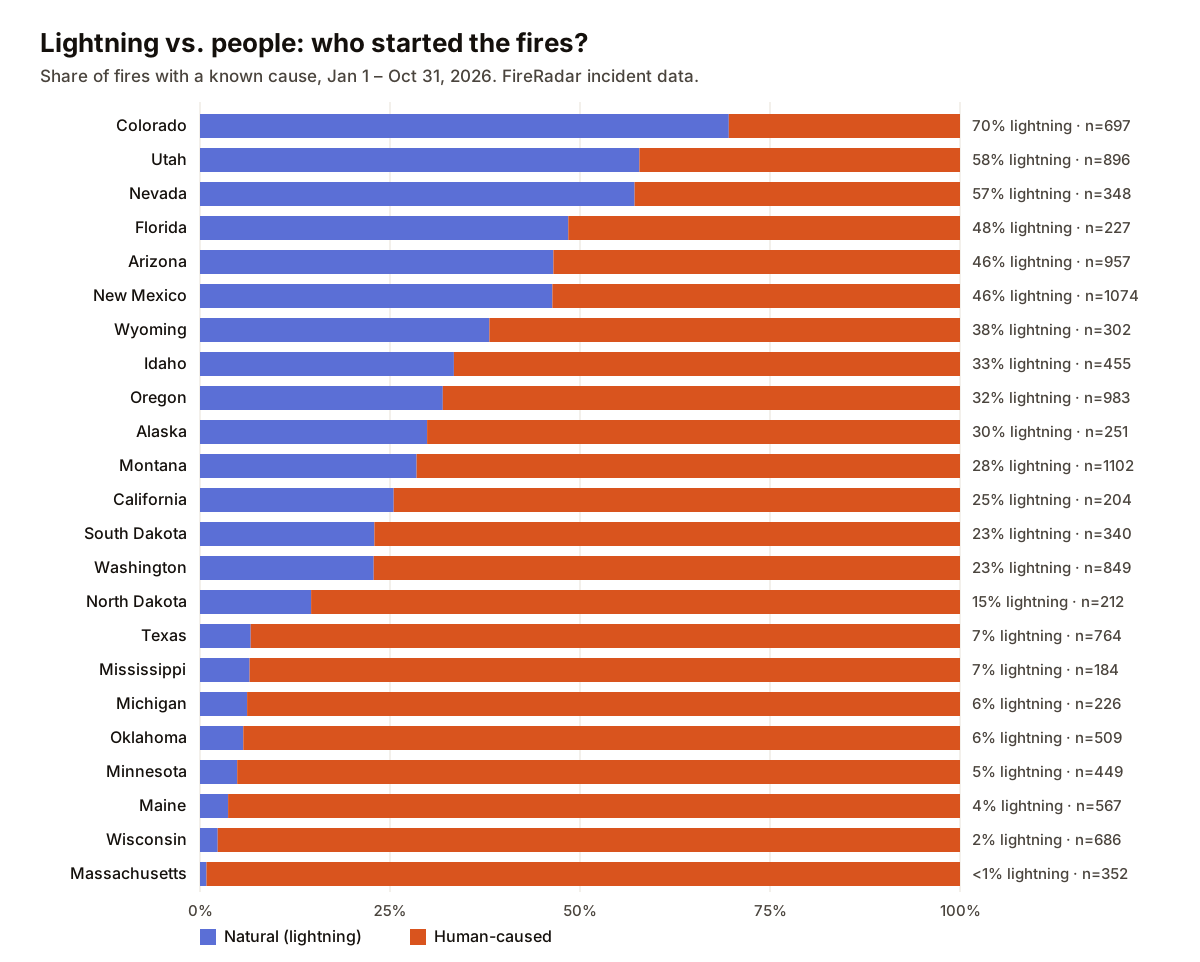
In Colorado, lightning started 70% of fires with a known cause. Utah (58%) and Nevada (57%) also had more lightning fires than human-caused ones — the only three states in the chart where that happened. Arizona and New Mexico (both 46%) were close to an even split. These are states with large areas of remote, high-elevation forest and rangeland, and summer thunderstorms — including the "dry" kind, which produce lightning with little rain reaching the ground. The Southwest monsoon, which usually starts in late June or July, adds to it. Outside the West, Florida (48%) stands out: it gets more lightning than any other state.
Where people start almost everything
At the other end, Massachusetts (3 of 352 fires of known cause), Wisconsin (16 of 686), Maine (4%), Minnesota (5%), Oklahoma (6%) and Texas (7%) recorded nearly all of their fires as human-caused. These states have more people living close to burnable land, and many of their fires are grass and brush fires in spring, before green-up, when debris burning, equipment and vehicles are the usual culprits.
The middle ground
The Northwest sat in between: Oregon at 32% lightning, Montana at 28% and Washington at 23%. These are places where a single thunderstorm can start dozens of fires in one evening, but where far more people live and travel near forests than in the interior West.
What this data can and can't tell you
- It's ten months, not a full year. Our records run to October 31, so they cover spring grass-fire season and the whole summer lightning season, but not most of California's fall and winter wind season, when many of its human-caused fires start.
- Treat California's figure with caution. Of 7,073 California records, only 204 — about 3% — had a determined cause. That clears our threshold for the chart, but it says more about when agencies update cause fields than about what's starting California's fires.
- Agencies classify differently. Some report a simple Human/Natural split; others use detailed categories such as debris burning or equipment use. We grouped them into the two broad buckets.
- Counts aren't acres. A lightning fire in a remote wilderness may grow far larger than a roadside fire that's out in an hour, so a state's share of fires says nothing about its share of area burned. We look at that separately in our post on fire size.
Why the split matters to you
In a state where people start most fires, prevention is the lever that actually works. The common causes are mundane: burning yard debris on a breezy day, a trailer chain dragging on pavement, a mower blade striking a rock in dry grass, an unattended campfire. Avoiding them on Red Flag days prevents most of the fires that start near homes.
In a lightning-heavy state, the risk is that several fires start at once, far from roads, and grow while crews are stretched thin. There, preparation matters more than prevention: defensible space around your home and a plan for leaving early.
Methodology: US incident records in FireRadar's database with a discovery date from January 1 to October 31, 2026, grouped by the cause field reported by the source agency. Natural includes lightning. Percentages exclude fires with an undetermined or missing cause. States with fewer than 150 fires of known cause are left out of the chart.